
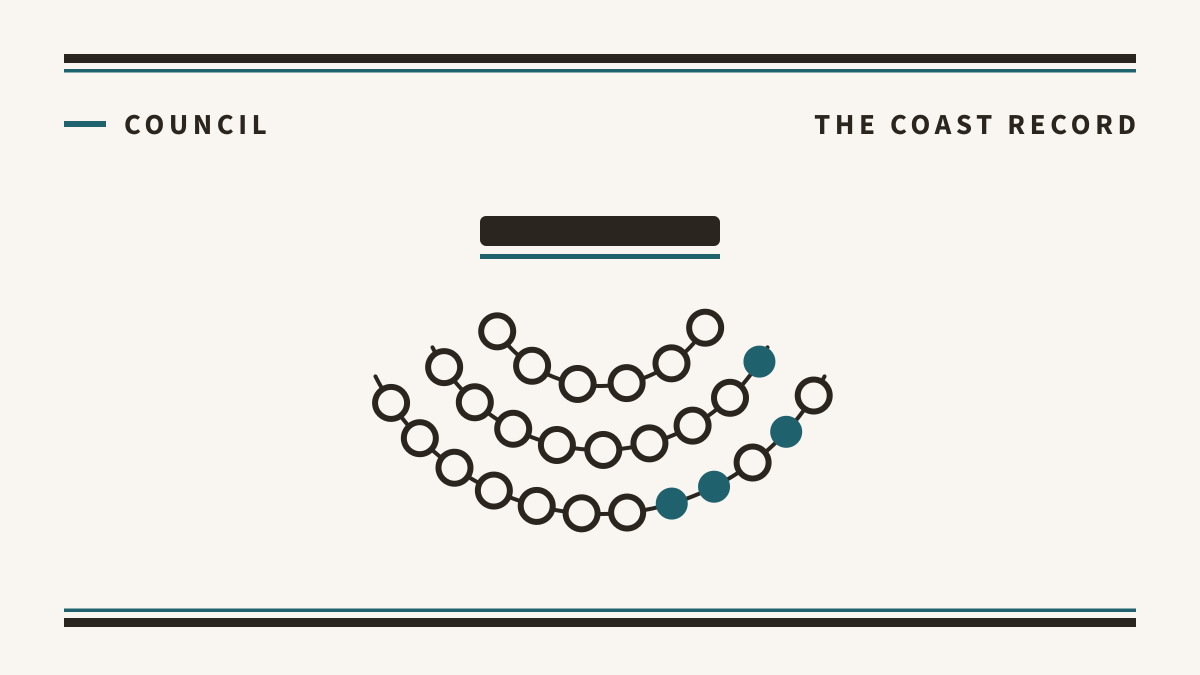
Updated 18 August 2026. This piece was published before the 28 July meeting and was written in the future tense. The meeting has since been held and we reported what it resolved: Jamie Loader was appointed Acting Chief Executive Officer, a permanent recruitment process was endorsed, and a seven-member panel was given delegated authority to run the search. The headline, the summary lines and the tense throughout have been corrected to past tense and anchored to the date, because a page still describing a three-week-old meeting as an upcoming one tells a reader something untrue. No fact in the story below has been changed.
On the afternoon of 28 July 2026 the councillors elected to run the Central Coast in September 2024
will do something the council has not had to do since before its financial crisis: choose
who runs the organisation day to day. Central Coast Council has called an
Extraordinary Council Meeting
for 4:00pm on 28 July 2026, at the council chambers in the Wyong Administration Building, and
its one substantive item is a Mayoral Minute headed Appointment of an Acting Chief Executive Officer and Commencement of the
Recruitment Process for a Permanent Chief Executive Officer
. Read plainly off the business
paper, that is the council starting its first chief-executive succession in five years.
What the 28 July meeting decided
The extraordinary meeting is short by design. Its agenda runs to procedural items, the
Mayoral Minute on the acting appointment and the start of recruitment, then a
Consideration of Resolution from Confidential Session
, which is the ordinary
way a council handles a staffing decision about a named individual: the deliberation and the
choice of person happen in closed session, with the resolution brought back into the open
meeting. So the public paper confirms the two things that are not confidential, that an acting
chief executive is being appointed and that recruitment for a permanent one is being started,
without yet naming who will step up. A separate ordinary council meeting is scheduled for the
same evening at 6:30pm, so 28 July was a double sitting.
The retirement itself has been public since early July. Regional coverage, including Coast Community News and NBN News, reported that David Farmer will finish on 2 September after a 45-year career in local government, and that the acting appointment is expected to be an internal one while the recruitment for a permanent chief executive runs. We have anchored the meeting, the acting appointment and the recruitment on the council's own business paper; the retirement date and the length of Mr Farmer's career are as reported by those outlets, and are noted as such in the methodology below.
The chief executive who arrived at the low point
To see why this transition is more than a routine personnel notice, it helps to remember where the council was when Mr Farmer arrived. Central Coast Council was created in 2016 by merging the old Gosford and Wyong councils. In 2020 it fell into a financial crisis serious enough that the elected councillors were stood down and the organisation was run by administrators. Mr Farmer was announced as the new chief executive on 2 March 2021 and commenced the following month, in April, with the council still under administration and its finances still being rebuilt. The council later declared it had ended that administration period in a strong financial position, and elected councillors returned at the September 2024 local government election.
By the council's own account the turnaround has held. When it adopted its 2026-27 budget in June, a $348.9 million capital works program, the council presented it as another balanced budget in a run of them since the rescue, and Mr Farmer, still in the chief-executive chair, spoke to the $22 million contingency built into the program. Whatever one makes of any single decision, the plain fact is that the executive now retiring is the one under whom the council went from not being able to fund its basics to planning at that scale.
Why the timing matters: a delivery machine, mid-build
Here is our read, built on the stories this masthead has reported through 2026 and labelled as analysis. Taken one at a time, a cluster of the council's recent moves looks like ordinary business. Taken together, they are one project: the council re-tooling itself into an organisation built to deliver big things. It has stood up a Mayor-led taskforce and a standing Major Projects Team around Gosford Coming Alive 2040, its framework for renewing the city centre around the confirmed fast-rail station. It has built an accelerated development-assessment process that has cut a long-standing backlog. It has reached for the Reconstruction Authority's faster approval route to move coastal-protection works at Wamberal around the usual planning logjam. And it has drawn up a list of major “key enabling” projects it wants senior governments to fund. The common thread is an organisation reorganising around delivery.
The honest qualification we have made every time is that these frameworks carry almost no money of their own. Gosford Coming Alive 2040, on a first-hand reading of its business paper, set no dollar figure and no numeric targets; its own next step is to write to the Premier and federal ministers seeking a funded partnership. The key-enabling-projects list is, by definition, a set of asks of Sydney and Canberra. So the council has spent 2026 organising itself to pursue money that other governments still have to agree to hand over. That is the backdrop the CEO transition lands against: the person who rebuilt the finances and under whom this delivery re-tooling has happened is leaving just as it needs to convert organising into funded projects. A smooth succession is not a formality here; it is the difference between momentum kept and momentum lost, and it is why an otherwise procedural meeting was worth a resident's attention.
What we do not yet know
Three things are still open. Who the acting chief executive would be was a decision taken in that evening's confidential session, so it was not in the public paper. How long the acting arrangement runs depends on the recruitment the same meeting sets in motion, and permanent chief-executive searches at a council this size typically run for months. And whether the delivery push holds its pace through the handover is exactly the thing a new or acting chief executive inherits. The Coast Record will follow the appointment and the recruitment as they are reported through the council's own meetings, and will update the council reference page as the roles change.
Methodology
The extraordinary meeting (its date, time and place), the Mayoral Minute titled
Appointment of an Acting Chief Executive Officer and Commencement of the
Recruitment Process for a Permanent Chief Executive Officer
, the confidential-session item and the same-night ordinary meeting were
read first-hand from Central Coast Council's published business papers on 26 July 2026
(Source 1). David Farmer's appointment as chief executive and his April 2021 commencement,
and the council's statement that it ended its administration period in a strong financial
position, are from the council's own media releases (Sources 2 and 3). The 2026-27 budget
detail and the CEO's role in it are from our own primary-sourced report (Source 4). The
retirement date of 2 September 2026 and the description of Mr Farmer's 45-year career are as
reported by named regional outlets (Source 5); the council's public release feed did not
carry a standalone retirement release at the time of writing, and the confidential Mayoral
Minute body was not public, so those two specifics are attributed to that reporting rather
than asserted from a council document. The “delivery machine” reading is our
analysis, built on the linked Coast Record stories and clearly labelled as opinion.